

- Single Image File
Reindeer herding – vegetation impacts (Norway and Finland)
A very high-resolution false color Ikonos-2 satellite image of Jauristunturit in the border zone shared by Norway and Finland. Image acquired 28 June 2001.…
- Single Image File
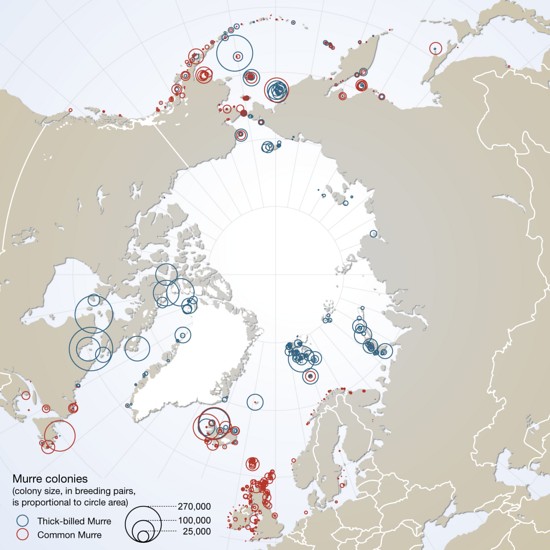
Murre colonies in the Arctic
The two species of murres (known as guillemots in Europe), the thick-billed murre, Uria lomvia, and common murre, Uria aalge, both have circumpolar distributions,…

- Single Image File
Definition of the geographic areas covered in the Arctic Biodiversity Assessment
The Arctic Council study on trends in the polar ecosystems - the Arctic Biodiversity Assessment (ABA) focuses on the areas displayed in this map.…

- Single Image File
Trends in Arctic vegetation productivity 1982-2005 (Greening of the Arctic)
Arctic vegetation has undergone enormous change in the past, most notably in response to the glacial and interglacial periods of the Quaternary. Data from…

- Single Image File
Distribution of common eider, breeding and wintering ranges in the Arctic
The common eider, Somateria mollissima, has a circumpolar distribution breeding mainly on small islands in Arctic and boreal marine areas in Alaska (Bering Sea…

- Single Image File
Distribution and current trend of polar bear subpopulations throughout the circumpolar Arctic
Polar bears occur in 19 relatively discrete subpopulations with an estimated worldwide abundance of 20,000– 25,000 animals. Our knowledge of the status and trend…
- Single Image File
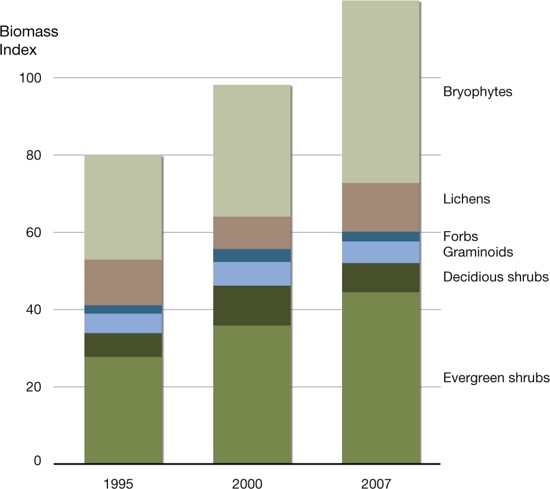
Trends in vegetation biomass, Ellsmere Island 1995-2007
Data from many sources and at several scales suggest that recent climate change is already affecting terrestrial Arctic ecosystems. Comparisons of historical and contemporary…

- Single Image File
Wild rangifer population trends
Wild reindeer and caribou, Rangifer tarandus, are widely distributed around the circumpolar Arctic where they play a key role in the environment, culture, and…

- Single Image File
The Arctic and the World – migration paths
The Arctic plays host to a vast array of biodiversity, including many globally significant populations. Included among these are more than half of the…

- Single Image File
Arctic sea ice food web – schematic illustration
Sea ice represents a unique ecosystem in the Arctic, providing habitat to specialized iceassociated species that include microorganisms, fish, birds, and marine mammals. Individual…

- Single Image File
Protected Areas in the Arctic
Protected areas have long been viewed as a key element for maintaining and conserving Arctic biodiversity and the functioning landscapes upon which species depend.…

- Single Image File
Arctic summer snow cover extent 1968-2008
The average snow cover extent during June, July and August across the Arctic (north of the polar circle) section of Eurasia and North America…