

- Single Image File
Drivers of the circular economy approach in wastewater management
The circular economy approach in wastewater management is applied through the diverse wastewater reuse or recycling options that are being practised all over the…

- Single Image File
Use of weirs and reservoirs
Many low-cost technologies and practices can significantly reduce health risks on- and off-farm. As part of on-farm measures, use of ponds, weirs and reservoirs,…

- Single Image File
Common on-farm ponds use in West Africa
Many low-cost technologies and practices can significantly reduce health risks on- and off-farm. As part of on-farm measures, use of ponds, weirs and reservoirs,…

- Single Image File
Outline of a circular economy
The circular economy is a preferred alternative to the linear wastewater and solid waste management approach of “store/collect, transport, treat, dispose”. It aims at…

- Single Image File
A typical example of the sanitation service chain with variation for urban and rural areas
Six types of circular economy are common to Africa, including treated water reuse for agriculture, reclaimed sewer wastewater for potable use, treated wastewater for…
- Single Image File
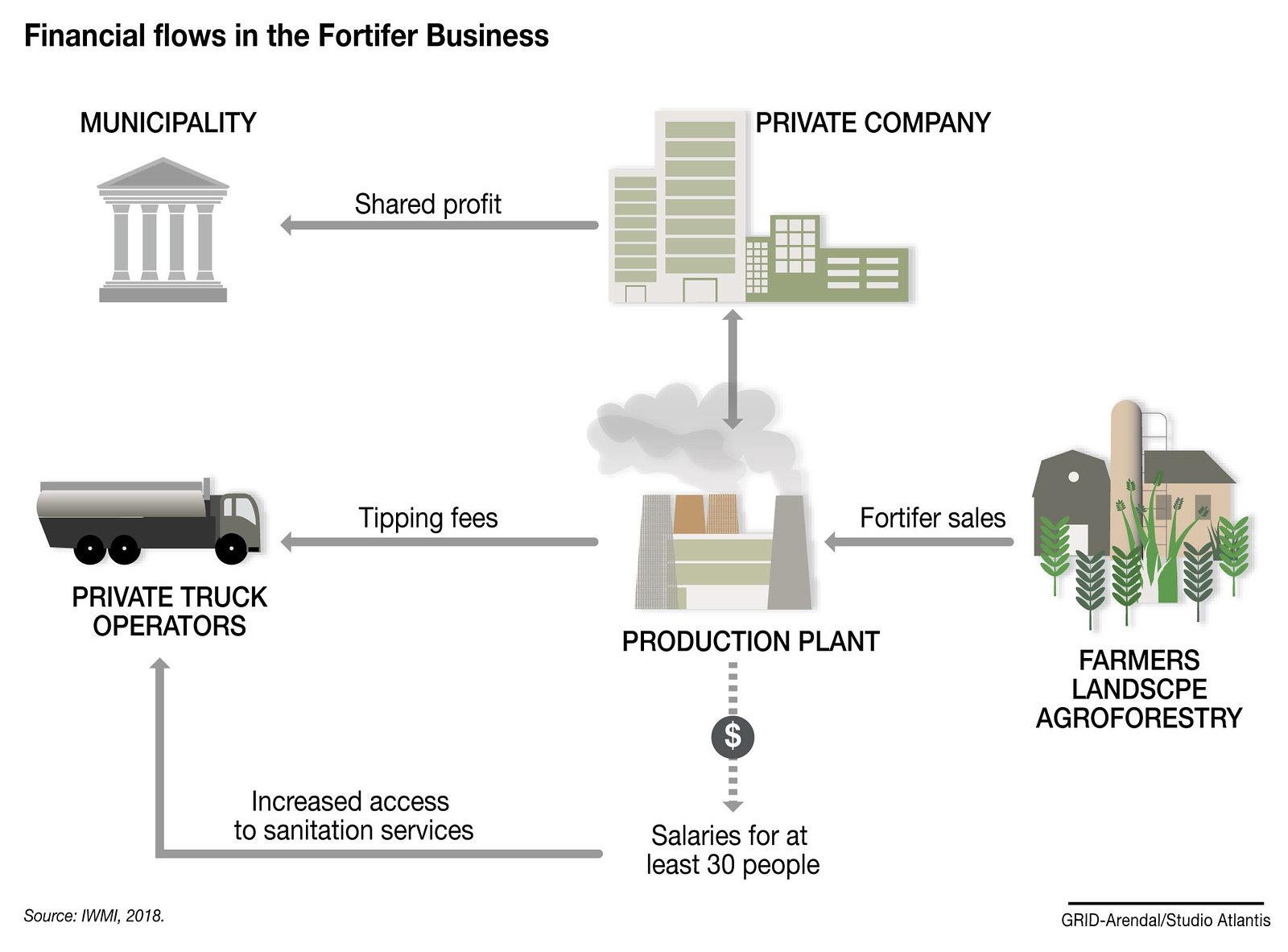
Financial flows in the Fortifer business
Under the public-private partnership arrangement, Jekora Ventures agreed the following implementation conditions with the Tema Metropolitan assembly: • the private entity bears the operation…

- Single Image File
Steps in the Fortifer production process
The Fortifer production plant in Tema and the Safi Sana production plant in Ashiaman, Ghana, are examples of non-sewered wastewater that is recycled for…

- Single Image File
Reduction of faecal coliforms on lettuce following application of risk-mitigation measures for safe wastewater irrigation
Implementing good post-harvest handling practices, such as washing by traders and processors (restaurants or households), can further improve the quality of farm produce. Experiences…

- Single Image File
Faecal coliform and helminth eggs over time in an on-farm pond in Kumasi
Figure shows the pathogen concentration as a function of the water retention time in a pond, though these solutions may not always be financially…

- Single Image File
WHO’s multi-barrier approach to reduce health risks in wastewater reuse
In general, only 10 per cent of the wastewater generated in the world receives some form of treatment (Thebo et al. 2017). Africa has…

- Single Image File
CEA 5 business model
Untreated wastewater is used for crop irrigation, usually in an uncontrolled and unregulated manner. This practice can be made safe by setting up risk…

- Single Image File
Stakeholder diagram for Durban Water Recycling
Figure presents a stakeholder diagram for the Durban wastewater recycling project. The total investment in the project was R72 million (US$4.858 million). Equity from…